


Most business owners I know would describe their management style as pretty hands-off. Collaborative. They trust their team.
And then I ask: what happens when a deliverable goes out without your review? How many decisions got escalated to you last week that probably didn't need to be? If you took a month fully off, what would break?
The answers are usually pretty revealing.
Here's what's actually going on in most of these businesses... the owner isn't controlling everything because they're a micromanager by nature. They're controlling everything because the business was built that way. When you're the only person in the business, every decision runs through you by necessity. That's not a flaw, necessarily, it's just how it works when you're building - you wear all the hats. The problem is that most businesses keep that structure long after it stops making sense. The team grows, the work expands, but the decision-making architecture stays the same: everything still flows to the top. Not because anyone chose that. Because nobody chose anything different.
That's what a default business looks like → one that just happened into its structure rather than designed it, shaped by whatever worked in the early days and never revisited. Default businesses aren't broken. They're doing exactly what they were designed to do. The problem is that a structure built for a solo operator running everything herself doesn't work the same way when there are people, clients, and complexity in the mix. It just creates a different kind of chaos, one where the owner is the bottleneck for everything and can never actually step back.
The alternative is what I call building a calmer business. Not calm as a destination or a personality trait. But as an ethos. A commitment to making intentional shifts toward a business that's more sustainable, more resilient, and less dependent on you being in the middle of everything all the time. It doesn't happen by accident. It has to be designed.
The Calmer Framework™ is the model for doing that. It identifies four levers - specific dimensions of your business, each sitting on a spectrum between default and calmer, each adjustable. As a business owner, these are areas that you can proactively pull and control and understand in order to make your business calmer.
The goal isn't to overhaul everything at once (because that would be exhausting and just make the problem worse). Instead, the goal is calibration - you find where there's the most room for improvement and take tiny actions towards something calmer. Eventually, those tiny actions start snowballing into a business that is just... easier.
Management Style: From Authoritarian to Autonomous
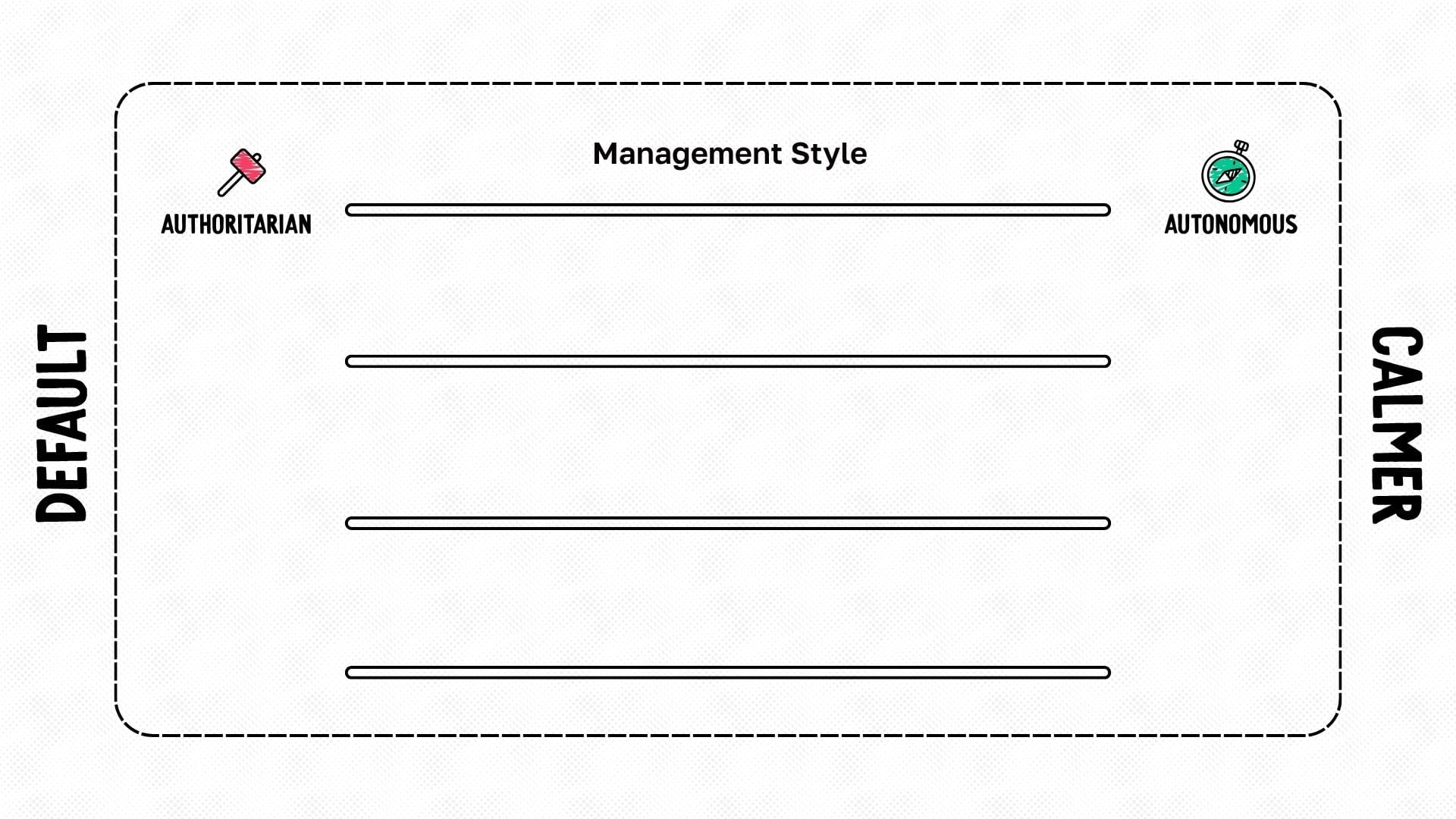
The first lever in The Calmer Framework™ is Management Style, which is all about how you manage both yourself and your team. It sits on a spectrum that, on the default end, is authoritarian. That's the culture, the way we're taught, what we're shown. The owner is constantly in the weeds, giving orders and trying to control every aspect of the business. They're in charge and they make all the decisions. If you've ever worked in any kind of corporate environment, you're probably pretty familiar with this management style.
On the other end of the spectrum, the calmer end, the style is more autonomous. In an autonomous work environment, individual team members are empowered to make their own decisions without being controlled by anyone else. Think of autonomy as the ability to self govern. So, folks can choose their own work schedule. They get to decide where, whether that's remote or in an office. Maybe they can manage their own budgets or make decisions about which projects to work on. In an autonomous management style, your team has ownership of their roles and their decisions.
Where authoritarian management style is all about control, autonomous style is all about trust. And when you trust your people, you free yourself up to focus on the bigger picture. You're not tied down by day-to-day tasks (because you're team has them under control), and you can lead more strategically.
So, on the journey to move from a default business to a calmer business, one major lever you can pull is focusing on transitioning from a more controlling, authoritarian management style into a more autonomous work culture - which is calmer for you and for your team.
Authoritarian Management Style
What does this default look like in practice?
You've got a small but growing team. A project manager, a couple of contractors, maybe a VA. On paper, you've delegated. In practice, everything still comes through you. Every deliverable gets your eyes on it before it goes out. Every client decision gets escalated to you for a final call. Every time someone runs into a problem, they wait for you to tell them what to do. You're reviewing, approving, redirecting, correcting... constantly. You tell yourself it's because you have high standards. And maybe that's true. But the real reason is that you don't fully trust that things will get done right without you in the middle of them.
The result: you're the bottleneck for everything. Your team can't move without you, so they wait. Your calendar is full of check-ins and reviews that shouldn't require your involvement. You're doing the work you hired people to handle, just one step removed.
Autonomous Management Style
Here's what the calmer end looks like.
Same business, different structure. Your team has clear ownership of their areas - actual ownership, not just tasks assigned by you. They are empowered to make decisions within their scope without escalating. When something unexpected comes up, they can handle it and loop you in after the fact. You find out about problems when they've already been solved, not when they need your intervention to move forward. Your job isn't oversight. It's creating the conditions for good work, then getting out of the way.
The distinction isn't discipline versus chaos. It's where the accountability lives. In an autonomous structure, accountability and trust are built in. Clear expectations, clear outcomes, clear feedback loops are part of the culture.
It's Not Just About Team Management
Before you assume this is only about your team, for most solo and small-team owners, the most authoritarian management relationship in the business is the one you have with yourself.
It's the belief that things only get done correctly if you're in the weeds of them. That delegation means things will fall apart. That oversight is leadership. It shows up as the inability to hand things off, the need to touch every decision, the guilt when you're not actively producing something.
And here's the part that makes this lever particularly hard to move: the skills that got you here - the deep expertise, the high standards, the eye for detail - are often exactly what keeps you stuck. You know how to do it best. Of course you do. So why would you let someone else do it?
Because when your expertise is the bottleneck for everything, you don't have a team. You have a dependency. And that dependency caps both your capacity and your calm.
Calibrating this lever doesn't mean abdicating. It means building the trust, the systems, and the decision rules that let other people do their jobs without you in the middle of everything. It means getting honest about what actually requires your judgment, and letting everything else go.
That's uncomfortable. It's also where a whole lot of margin is waiting.
What's Your Management Style?
If you're trying to figure out where you land on this spectrum between authoritarian and autonomous, here are a few questions worth sitting with:
- When someone on your team makes a decision without checking with you first, what's your gut reaction? Relief... or anxiety?
- How many things got approved, reviewed, or redirected through you in the last week that didn't actually need your involvement?
- If you took a week fully off, what would break, and why would it break?
- What would need to be true for you to trust your team to make a decision without looping you in first?
If most of those questions landed and felt... a little uncomfortable, that's really useful information. It means that you've got plenty of opportunity to make things calmer.
It doesn't mean you need to overhaul how you manage everything at once. That's not calibration, that's a renovation, and heading down that path would likely make things worse, not better. The right move is smaller than that. Pick one place where you're currently the bottleneck and ask:
What would need to be true to hand it off?
Not everything. Just one thing.
Maybe that's writing down how you make a specific type of decision so someone else could make it. Maybe it's letting a deliverable go through without your review and seeing what actually happens. Maybe it's being honest about which check-ins exist because they're genuinely necessary and which ones are just there because letting go of them makes you nervous.
The goal isn't to get all the way to full autonomy overnight (that's not realistic). It's to move the lever slightly - and notice what kind of margin that creates.
And if you're looking at your answers and thinking the problem might run deeper than just this lever, or you're not quite sure where to start, that's exactly what a Margin Reset is for. We look at how you're operating right now and identify where the highest-leverage shifts actually are.

