


You've built something real. You're not a beginner still figuring out the basics - you've been at this long enough to know what you're doing. And something still isn't working the way you thought it would by now.
Maybe the business has grown but the breathing room hasn't. Maybe a season of life shifted and the structure that used to hold everything stopped holding it. Maybe you're doing fine by every external measure and still feel like you're running on fumes. You've tried the tools, followed the best practices, done everything you were supposed to do.
And you're still exhausted. Still waiting for things to "calm down." (I'm pretty sure that's just not a thing as an adult).
Default Decisions
Here's what I've come to believe after years of working inside businesses like yours: that feeling isn't a discipline problem. It's not a focus problem. It's a structural problem. And it almost always comes back to the same root cause.
Your business was never intentionally designed.
To be fair, most businesses aren't. They default into existence - built reactively, on autopilot. I call these Default Decisions. They're the choices you make in your business without even realizing you're making them.
The software you chose because someone you respected used it. The service structure you lifted from others in your industry because that's just "how it's done." The pricing you set based on what felt competitive rather than what actually worked for your life. None of that felt like decision-making at the time. It felt like obvious next steps. Just what you're "supposed" to do.
But they were decisions. You just made them on autopilot.
And underneath almost all of them is a single belief so baked into how we think about business that most of us never thought to question it: growth at all costs. More clients, more revenue, more services, more team, more expansion. Some tech bro in a grey hoodie decided that's what a successful business looks like, and the rest of us just... went along with it. Without really asking whether we wanted that, or whether it worked for the life we were trying to live.
When you follow those defaults long enough without questioning them, you end up with a default business. And here's the part that makes this particularly infuriating: default businesses work exactly as intended. The chaos, the exhaustion, the sense of always being behind - that's not a bug. That's the system doing exactly what it was designed to do.
Pushing harder isn't going to get you somewhere different. Default businesses produce default outcomes. If you want different outcomes, you have to design for them.
What do you design for instead?
Calmer. Not calm, but calmer. That distinction matters more than it might seem.
Calm implies arrival. Some perfect, peaceful, steady state you eventually reach where everything is serene and under control and maybe there are candles involved. That's not what this is, and honestly, that's not something I'm selling (mostly because I'm pretty sure it doesn't exist). Calmer is a direction. A calibration. An ethos. A commitment to nudging your business, bit by bit, toward something more sustainable, more resilient, more actually-yours.
I'll be real with you: I am a deeply weird spokesperson for this concept. I'm intense, passionate, and genuinely nerdy about business operations in a way that probably concerns people at parties. I run at exactly two speeds: full intensity and complete stop. Tornado or potato. Nothing in between. Nobody has ever described me as chill... ever. But here's what I've figured out. You don't have to be a calm person to build a calmer business. Those are two completely different things. One is a personality trait. The other is a design output.
A calmer business isn't a smaller or less ambitious one. It's a more intentional one. It's more resilient than one running at maximum capacity all the time. It makes better decisions. It doesn't fall apart when something unexpected happens... and something unexpected always happens.
Over time, it's more sustainable and more profitable, because it's not burning through its most important resource. You.
But it doesn't show up on its own. If calm isn't something you're actively designing for, you won't accidentally stumble into it. The full argument for why this is worth designing for is here.
The Spectrum between Default and Calmer
Every business exists somewhere on a spectrum between default and calmer. Some are fully default - built entirely on autopilot, growth at all costs, nobody ever stopped to ask why they were doing any of it. Most have a mix: some levers pulled toward calmer, others still running on autopilot.
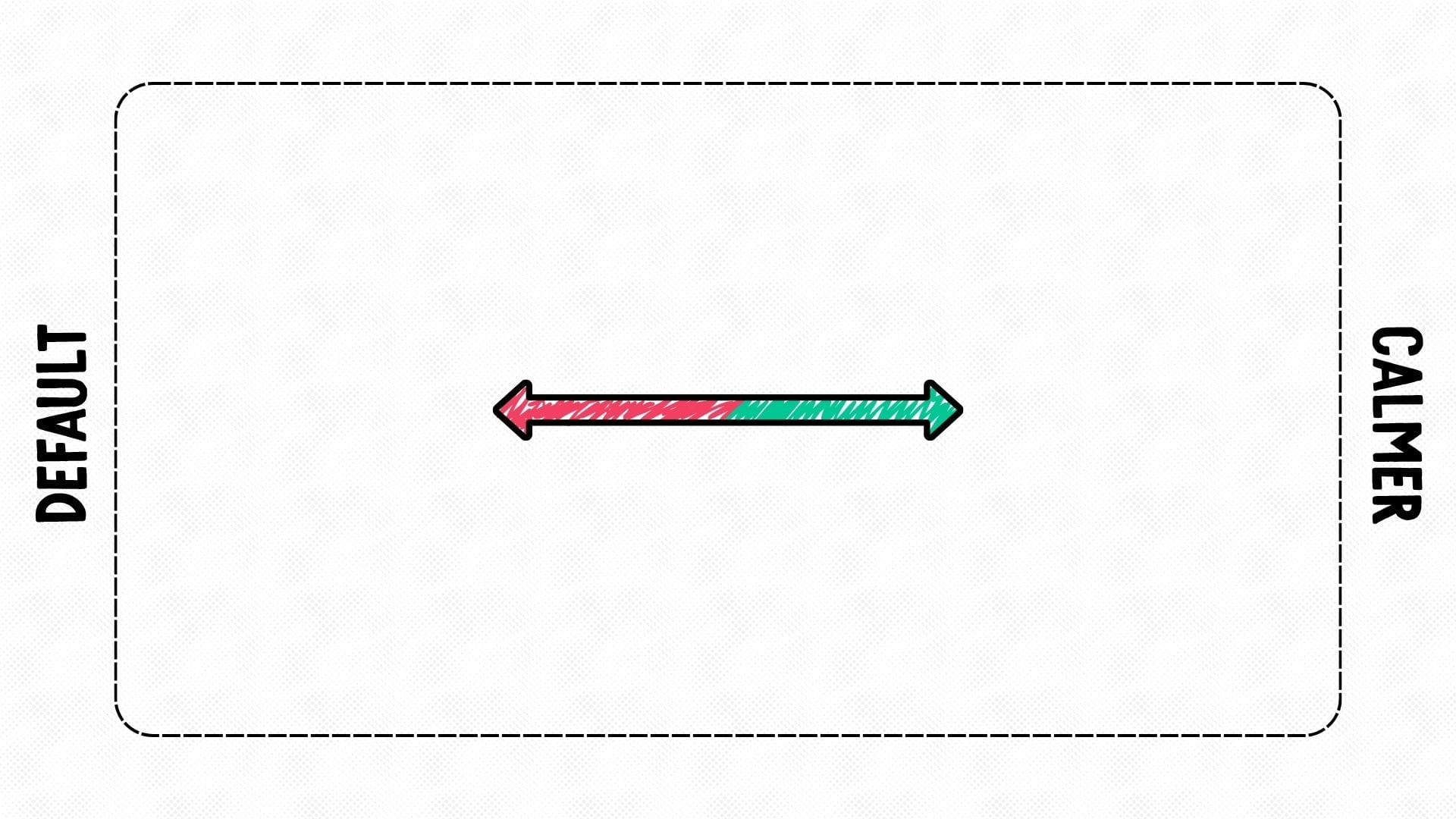
Either way, the framework works the same way.
The Calmer Framework™ identifies four levers - specific dimensions of your business where the most breathing room lives. Each lever sits on its own spectrum. Each one is adjustable. And each one, moved even slightly toward calmer, changes something real about how the business feels to run.
The goal isn't to move every lever simultaneously. That's not calibration, that's a renovation, and nobody has time or capacity for that. The goal is to find the lever with the most room to move and make one intentional shift. Then another. Tiny moves, consistently, in the right direction. That's how default businesses actually become calmer ones... not all at once, but over time.
Management Style
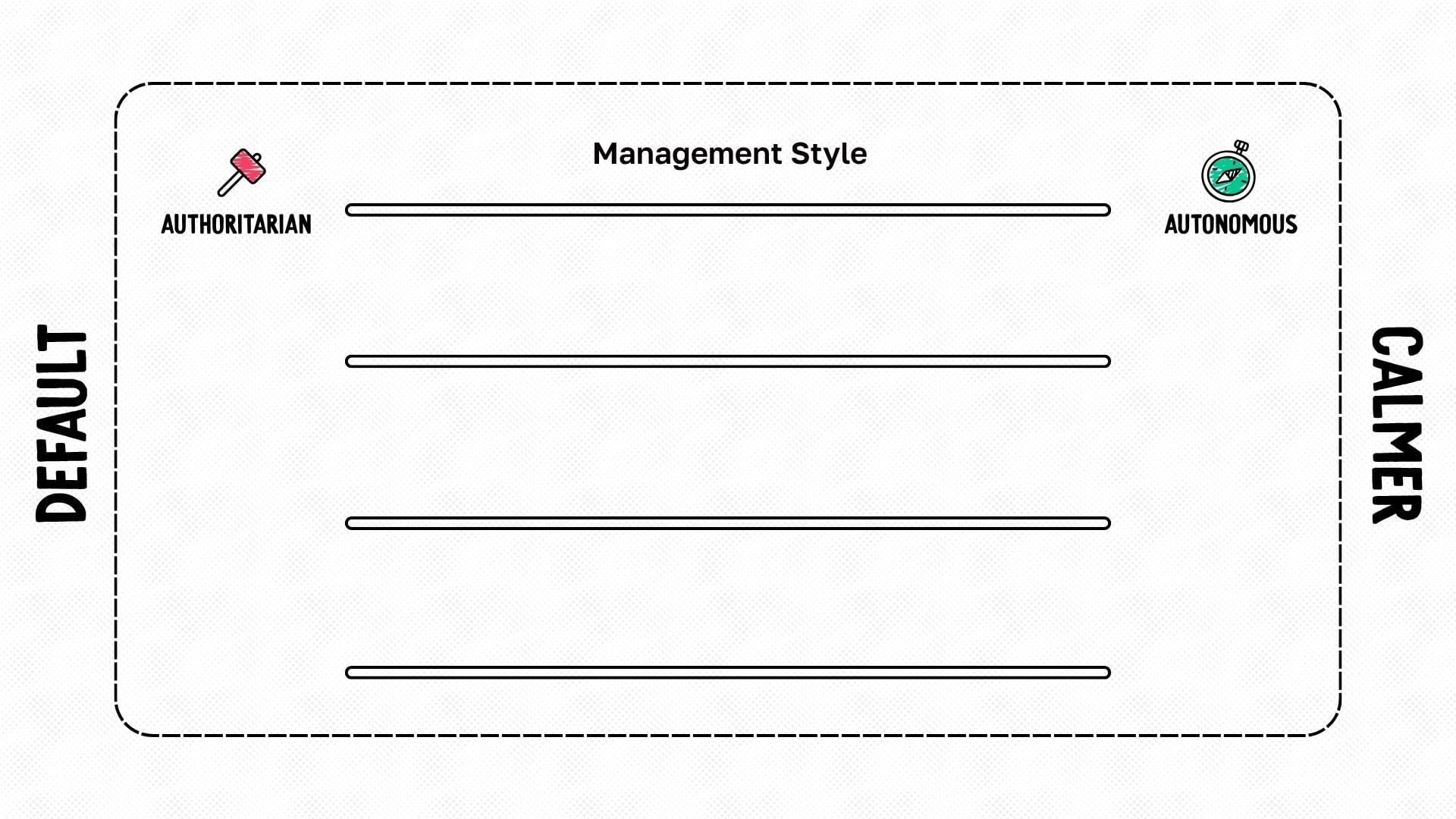
Management Style runs from authoritarian to autonomous. The default is control. The owner is in the weeds, monitoring everything, touching every decision. The calmer end is trust: teams that self-govern, where work is rewarded instead of watched. Worth noting: this lever shows up just as much in how you manage yourself as in how you manage other people. Go deeper on Management Style →
Values & People
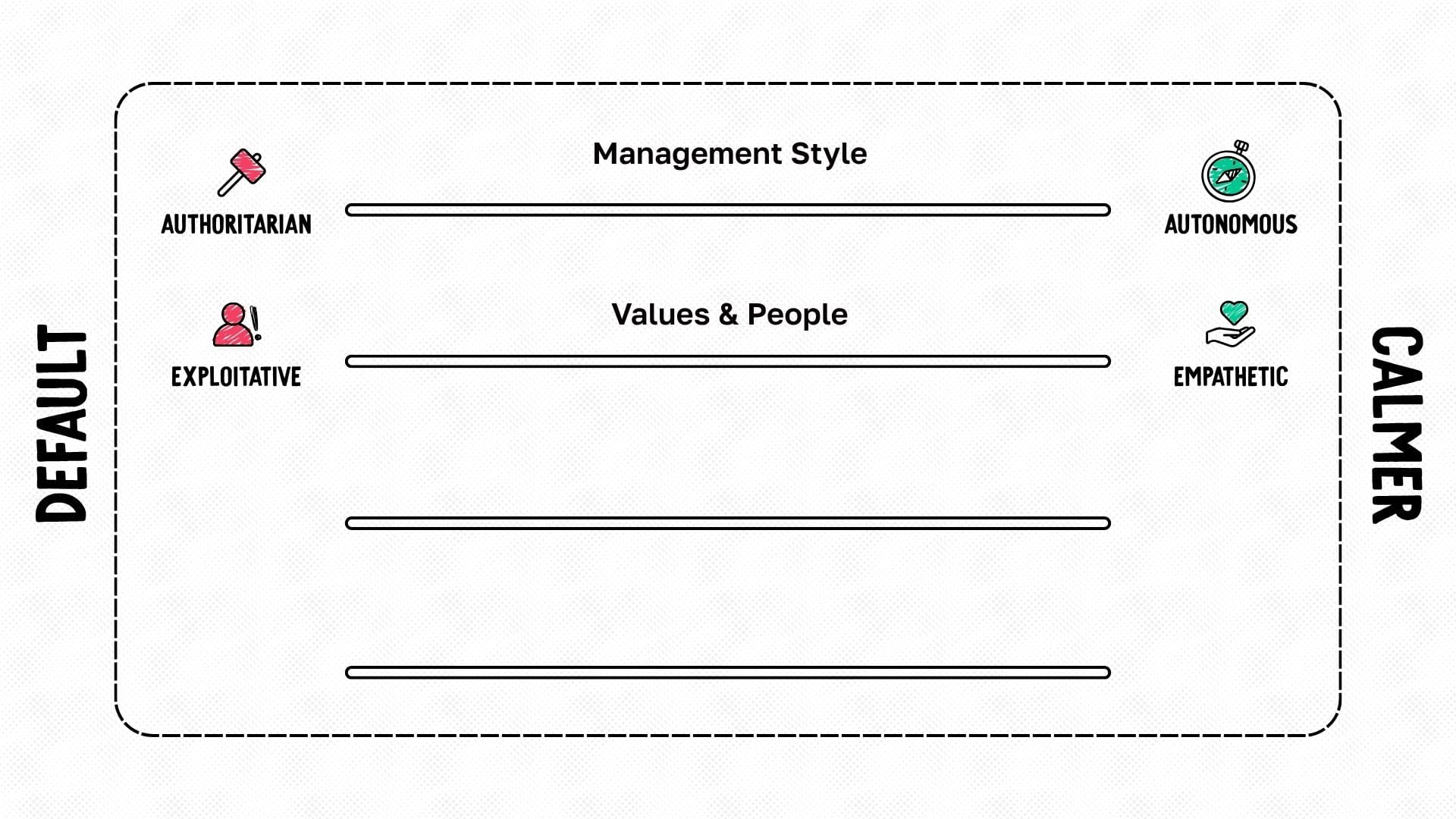
Values & People runs from exploitative to empathetic. The exploitative default treats people (including the owner) as cogs in the machine. How the team is actually doing doesn't really get considered. And values come second to financial success. The calmer version treats owner and team wellbeing as table stakes, not personal luxuries. A drained decision-maker makes bad decisions. That's not a feelings problem. That's a business problem. Go deeper on Values & People →
Business Design
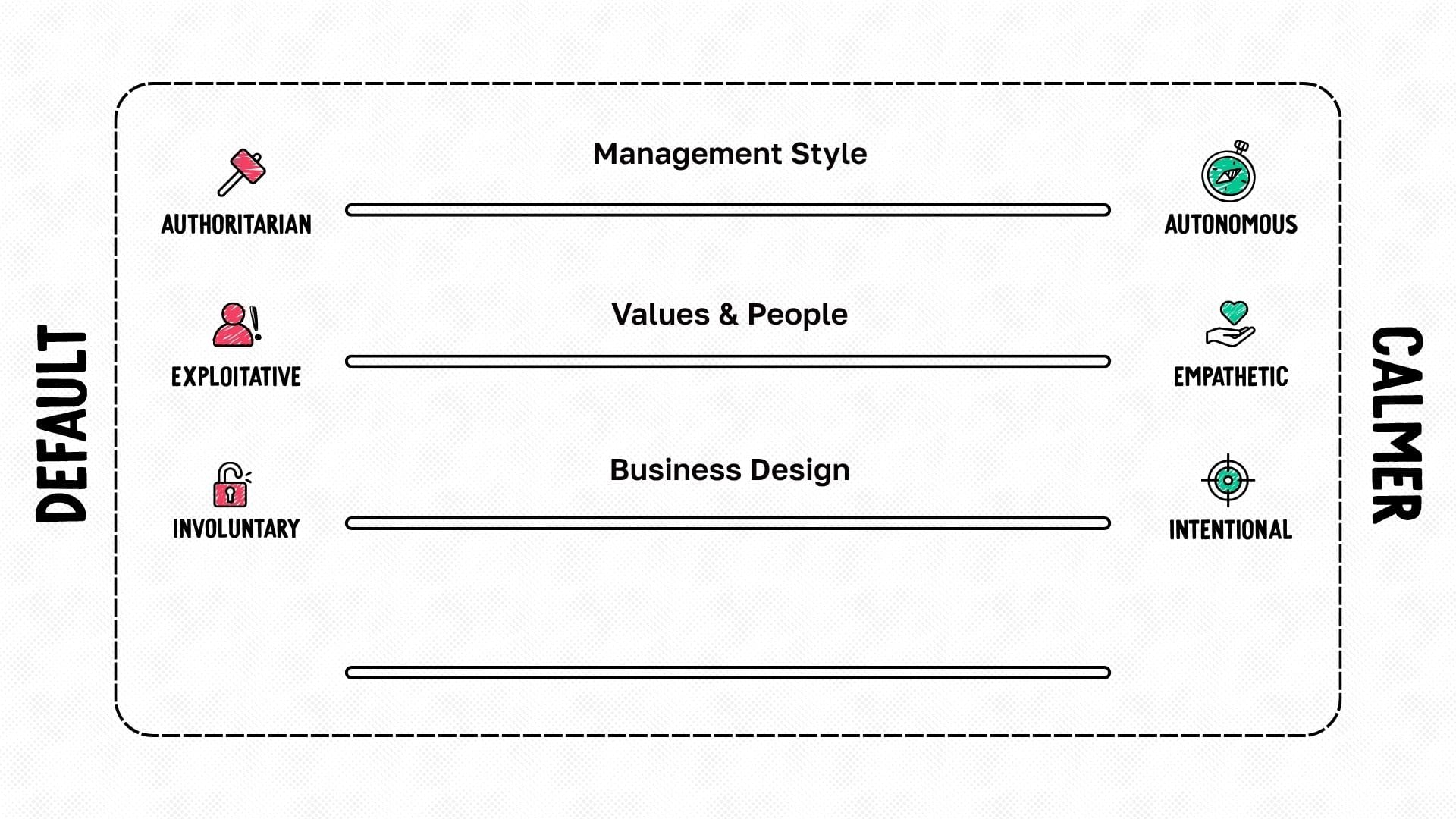
Business Design runs from involuntary to intentional. An involuntary business design is one you defaulted into... services structured like everyone else's, a business model some guru told you was the "right" one, delivery built around what seemed like you "should" at the time instead of around how you actually work best. Intentional design starts with you: your definition of success, your rhythms, your real constraints. Then builds backwards from there. Go deeper on Business Design →
Margin Mindset
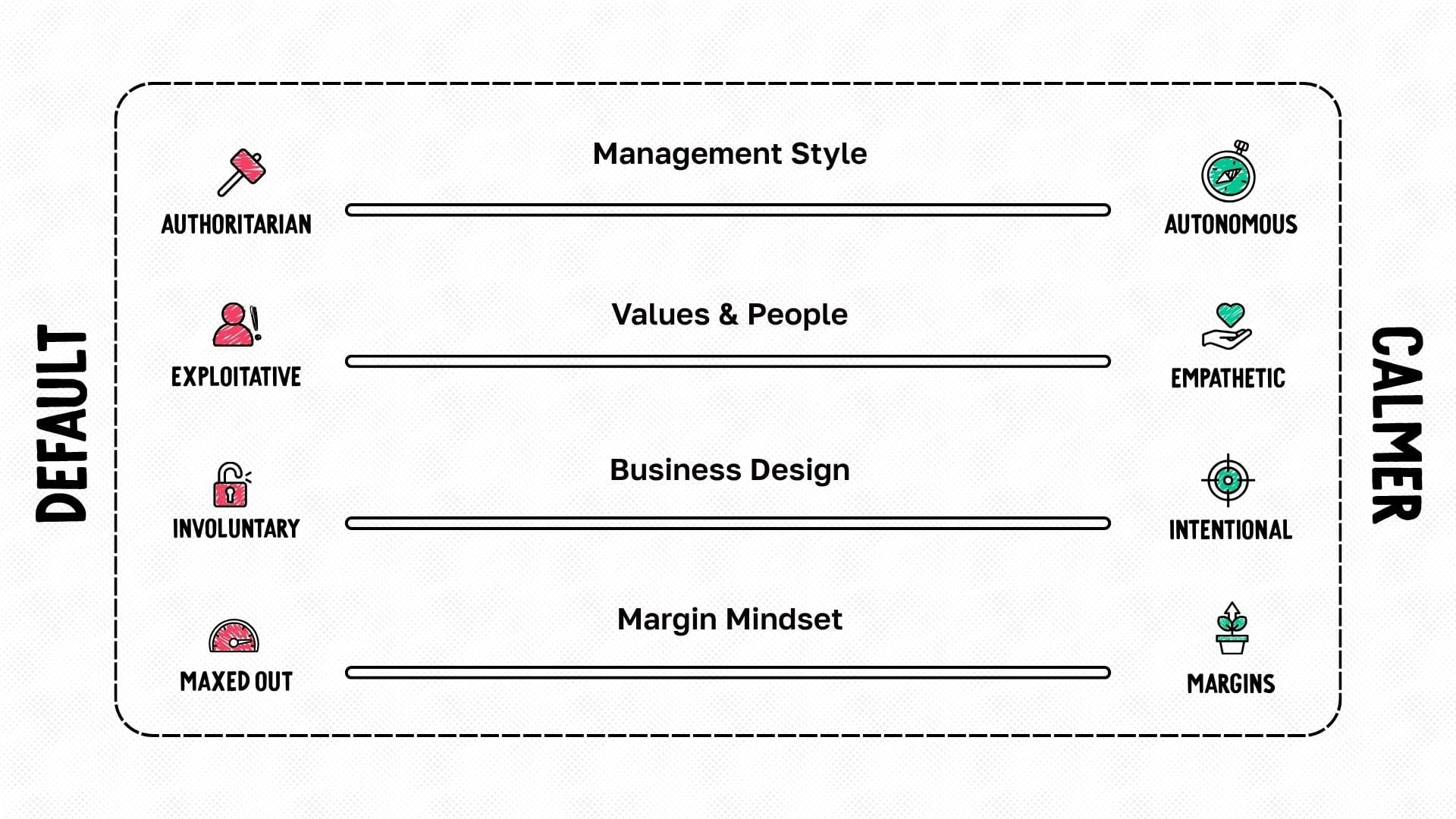
Margin Mindset runs from maxing out to creating margins. Both default and calmer businesses care about efficiency. The difference is what you do with what efficiency frees up. The default fills that space with more work - cram the most productivity into the time available, always. The calmer approach uses it to build margins instead: resource margins, energetic margins, emotional margins, creative margins. Margins are the breathing room that makes everything else sustainable. Go deeper on Margin Mindset →
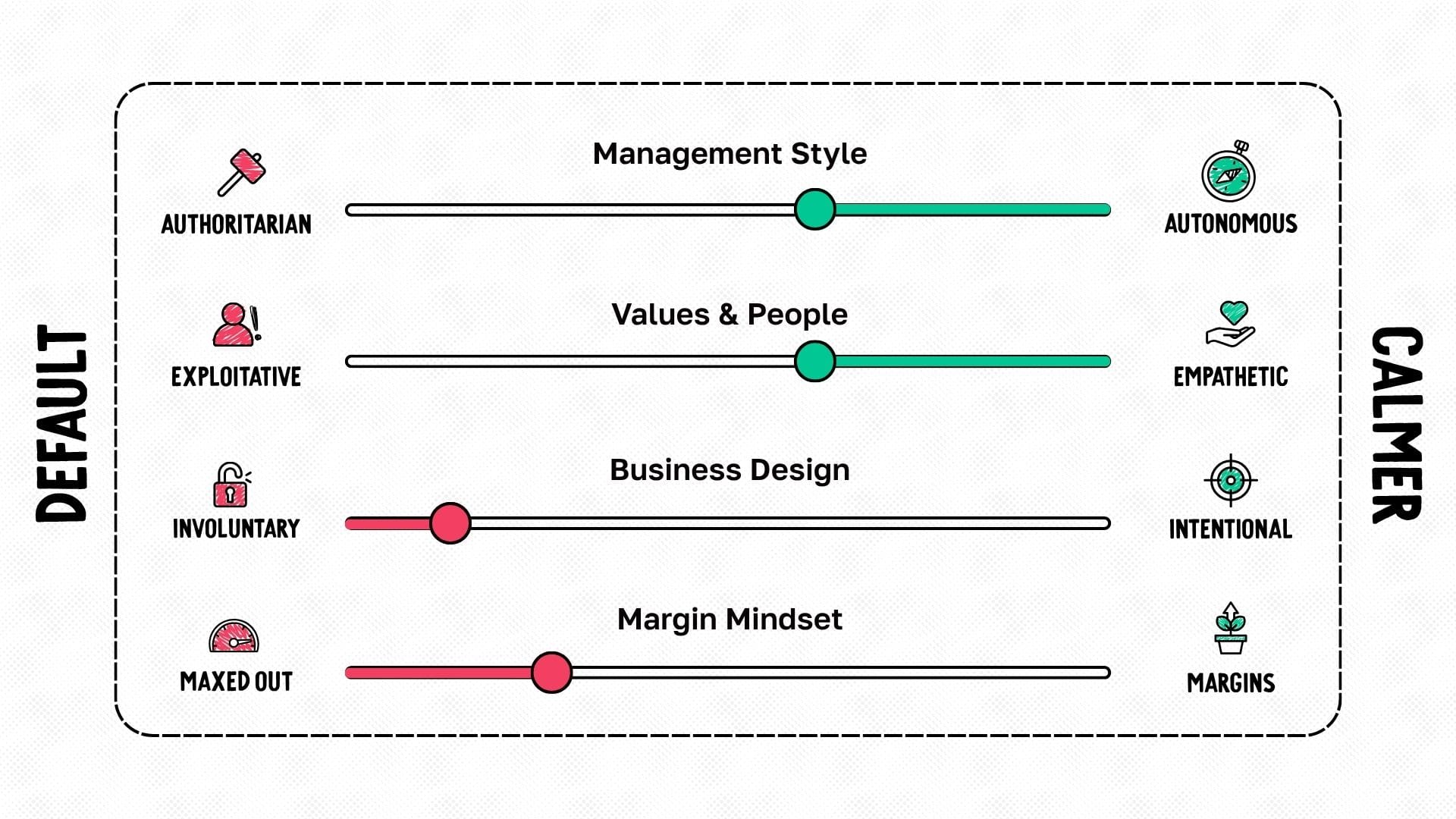
Some businesses are fully default. They're built entirely on autopilot, without ever considering alternatives. Most have a mix: some levers pulled toward calmer, others still just the default. Either way, the framework works the same way. Find the lever with the most room to move. Make one intentional shift.
Because the good news about a structural problem is that it has a solution. You don't have to work harder inside a structure that doesn't work for you. You can look at the structure itself, figure out what it was actually built for, and intentionally make a choice to start building towards something different.
That's what this is for. Not a wholesale redesign. Not burning down what you've built. Just getting clear on where you are, and making one intentional move at a time toward calmer.

