


Your business is designed. You just probably didn't do it.
That sounds harsher than I mean it. Most owners didn't wake up one day and decide to build something that would consistently run over capacity, make the same decisions harder than they needed to be, or turn the owner into an irreplaceable bottleneck. It just... happened. Because the business grew in the direction of whatever worked - whatever clients responded to, whatever kept revenue stable, whatever felt urgent that week. And now you've got a business that runs like it was assembled in motion, because it was.
That's what an involuntary business design looks like. It's not a business that's broken. It's a business doing exactly what it was designed to do. The design just wasn't intentional.
The Calmer Framework™ is a model for making that shift → from default to deliberate, from inherited structure to intentional design. It identifies four levers in your business, each sitting on a spectrum, each adjustable. The third lever is Business Design, and it's often the one where the most leverage is hiding.
Business Design Lever
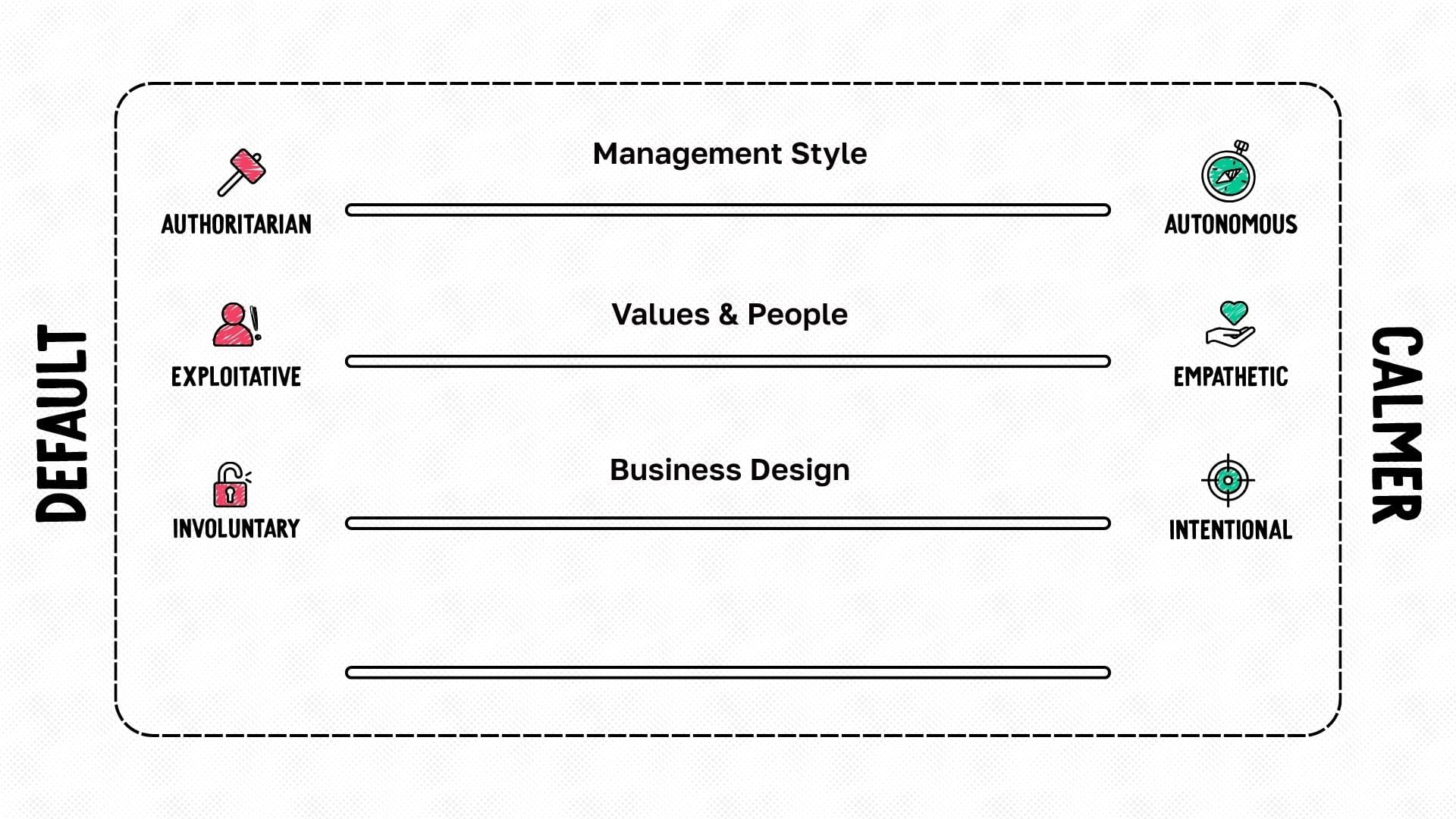
On the default end, business design is involuntary — meaning the structure of the business accumulated rather than being chosen. Services got added because a client asked and it seemed like a good idea at the time. Pricing got set based on what competitors were charging or what felt like too much to ask. The client experience got shaped by whoever was loudest or most demanding. None of it was wrong, exactly. It was just... reactive. Built in motion.
On the calmer end, business design is intentional — meaning the structure of the business was actually chosen, with intention, around how the owner works best. Services are designed for sustainable delivery, not just to close the sale. Pricing reflects the actual cost of doing the work well, including the energetic cost. The client experience is built around how the business can deliver consistently, not just how to land the project. Nothing was assumed. Everything was examined.
The gap between those two descriptions is where most of the friction lives.
What the Involuntary End Looks Like
Take a service business that's been running for five or six years. Revenue is solid. The work is good. Clients keep coming back and referring new clients. And yet... there's always more on the plate than capacity to hold it. The owner is almost always the bottleneck. Delivery feels harder than it should, even during a normal week. A slightly busier month throws everything off. Something new gets added to the mix every quarter, but nothing ever gets taken away.
This isn't a productivity problem. It's a design problem. The offer ecosystem was never built to hold a business this size, at this pace, with this team. It was built to close the next client and figure the rest out later. And at some point "later" became now, and now it's just how things run.
What's tricky about this pattern is that it doesn't look like a crisis from the outside — and often doesn't feel like one from the inside until it does. The business isn't failing. It's just quietly running at a pace that isn't actually sustainable. And because nothing is dramatically wrong, there's no obvious moment to stop and redesign it.
What the Intentional End Looks Like
Same business. Different design decisions made along the way.
The services are structured to be delivered without the owner being the single point of contact for everything. Pricing was set to support the actual cost of the work — not just the hours, but the capacity and energy required to do it well. Clients were onboarded into a clear structure that tells them what to expect, when, and how — so the owner isn't spending half her time managing expectations. Decisions about what to add, what to change, and what to cut get made against a clear set of criteria: does this work within our actual capacity? Does it generate the margins we need? Does it fit how we actually work best?
The business isn't perfect. But it was built with intention, and it shows — in how sustainable it is to deliver, in how the owner feels at the end of a normal week, in how the team functions without her needing to be in the middle of everything.
When the Model Changes But the Structure Doesn't
One of the clearest examples I've seen of involuntary business design: when the business model shifts but the underlying structure doesn't adapt with it.
I worked with a marketing agency that had gone through exactly this. They'd moved from large retainers with a handful of clients to a model with more clients, smaller deals. Revenue was fine. But they were, as the owner put it, "drowning in proposals." She came to the call ready to solve for volume — maybe better processes, maybe more team capacity.
And then she said something that changed the direction of the whole conversation: "We need CPR, not a CPR class."
My response: "Before we do CPR — we need to figure out where to do it."
Because the problem wasn't that they needed to move faster. It was that they were running a new business model on an old structure. The chaos wasn't a capacity problem. It was an old foundation under a different building. You could add all the processes in the world and it still wouldn't hold, because the design itself hadn't changed.
That's what unexamined business design does. It creates friction that looks like an execution problem, when it's actually a structural one.
One Place to Start
If you're trying to get a sense of what a more intentional service design might look like for your business — the Calm Service Design + Delivery Swipe File is a good starting point. It's a collection of the design moves I see working across the service businesses I work with: ways to structure delivery, create more repeatable work, and build offers that don't require the owner to be the answer to every question. Free, and it'll give you a sense of the kinds of decisions worth revisiting.
→ Get the Calm Service Design + Delivery Swipe File
Where Do You Land on This Lever?
A few questions worth sitting with:
If you had to explain how your current service offering came to exist — could you? Or did it mostly just... accumulate?
Which parts of your business feel the hardest to deliver consistently, and have you ever asked whether that's a design problem rather than an execution problem?
If you had to start over and design your services specifically around how you actually work best — what would you change first?
If you brought on someone new to deliver your core service — would they be able to do it well without you in the middle of everything? If not, what's missing?
What to Do With Your Answers
If something surfaced in those questions, that's where the leverage is. Not a reason to overhaul everything at once — that's just trading one kind of chaos for another. But a place to start.
Pick one thing that feels structurally off — not a symptom, the thing underneath it — and ask what an intentional version of it would look like. Maybe that's a service that needs to be redesigned so it doesn't put you in the bottleneck every time. Maybe it's pricing that's never actually reflected the real cost of the work. Maybe it's a client intake process that was set up fast and never revisited.
The goal isn't to get to fully intentional overnight. It's to move the lever slightly — and notice what that creates.
And if you're looking at your answers and thinking the offer design is the thing that's been quietly exhausting you — if there's always more work than you can actually hold — an Offer Reset is probably the most direct path forward. We map what your current offer ecosystem is actually asking of you, find where the design is working against you, and figure out what to recalibrate.

