


Default businesses and calmer businesses both normally focus on becoming more efficient. But the real distinction between the two is what they do with those efficiency gains.
Default businesses are all about shoving more into those margins that efficiency creates... more projects, more work, more... more... more. But calmer businesses use those gains to build space (otherwise known as margin).
The Calmer Framework™ is a model for making intentional shifts away from default business design. It identifies four levers - specific dimensions of your business, each sitting on a spectrum between default and calmer, each adjustable. The goal isn't to overhaul everything simultaneously. It's about calibration and finding where there's room to move and making one intentional shift at a time.
The first three levers are about how you manage (and who manages whom), how you treat the people inside the business, and how the business itself is structured. This fourth one is different. It's about what you do with whatever the other three free up.
Margin Mindset is the lever that determines whether getting calmer actually compounds - or whether every efficiency gain just gets quietly absorbed back into more output.
Margin Mindset
You got more efficient. And somehow you ended up with more to do.
If that sounds familiar, you're not doing it wrong. You're just using efficiency the way almost every business uses it by default - as a tool for doing more. You shaved time off a process, and filled the gap with another project. You automated something, and added a new service. You hired someone to handle the work, and took on another client. The freed-up capacity went right back into output.
That's not a discipline problem. It's a direction problem. Efficiency is a tool. The question is what you're pointing it at.
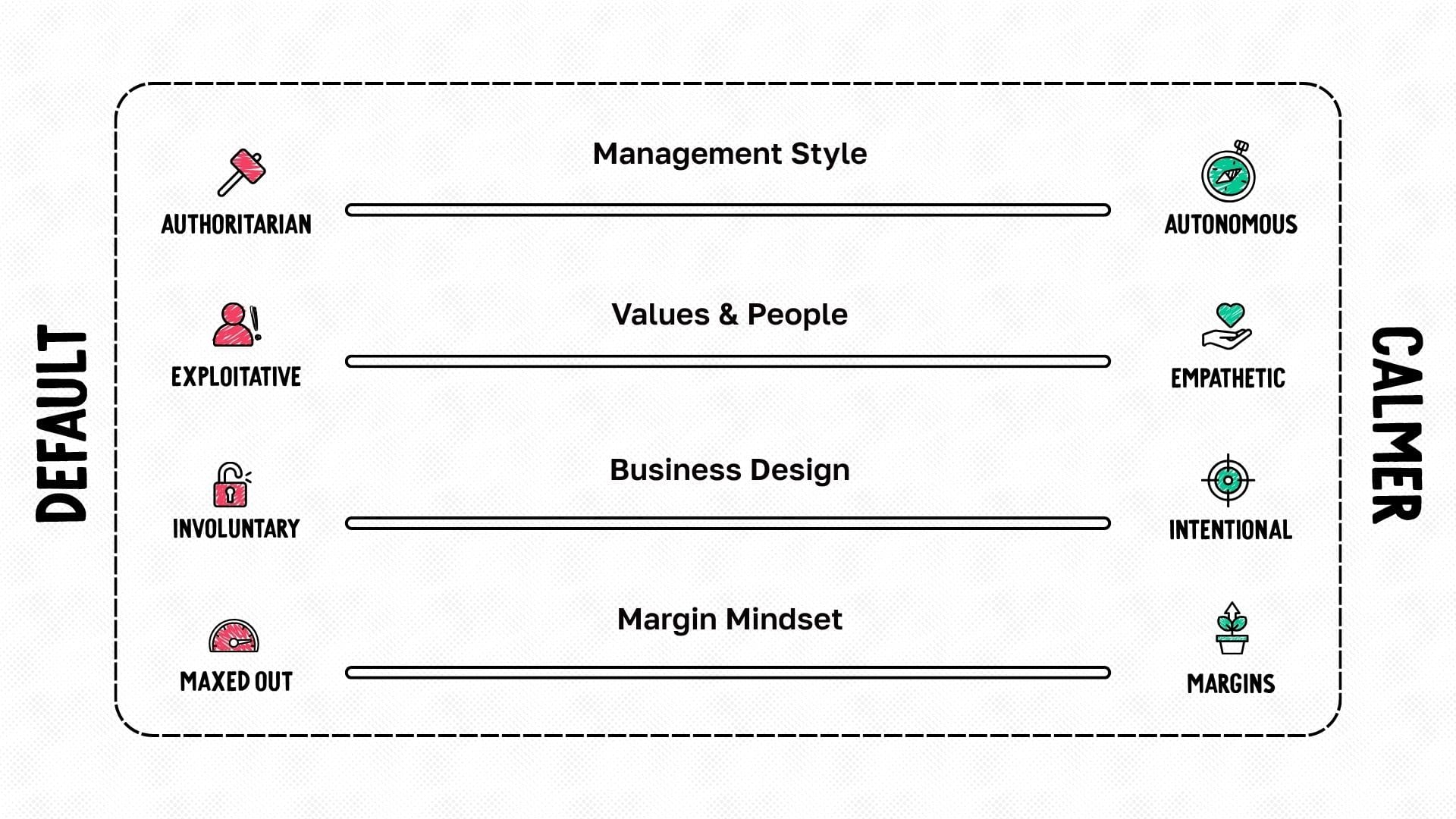
The default business points it at output. The calmer business points it at margins.
The fourth lever in The Calmer Framework™ is Margin Mindset, and it sits on a spectrum between maxing out on the default end and creating margins on the calmer end. Both ends care about efficiency. The difference is what you do with what efficiency creates.
Maxing out fills every freed-up hour back up with more work - more volume, more clients, more output. Creating margins uses that same freed-up space to build breathing room into the structure of the business on purpose.
Margins are what make everything else sustainable. And most businesses are running without them.
The Maxing Out End
Here's what the default version of this lever looks like in practice.
The business is running well enough. Revenue is solid, capacity is full, things are moving. You've built some systems — a project management tool, a client onboarding workflow, maybe some automation. Efficiency exists in pockets. But the gains keep getting absorbed. Every time something gets smoother, there's another project to fill the space. The business grows to meet whatever capacity is available. There's always a good reason for it.
The result: the business is profitable on paper... and the owner is exhausted. There's money in the bank and no time to think. Revenue is up and there's no slack in the system for anything unexpected. Which means the next big client is both a win and a problem. Which means taking a real week off isn't a vacation, it's a logistical puzzle. Which means making a strategic decision from a place of actual clarity hasn't happened in six months.
Profit margins are real and necessary. But a business can be financially profitable and completely depleted in every other dimension. That's what maxing out creates.
The Creating Margins End
Same business, different mindset about what efficiency is for.
When something gets more efficient — a deliverable takes less time, a system reduces back-and-forth, a team member takes something off your plate — the default question is "what can we do with that capacity?" The calmer question is "can we just... not fill it?"
Because margins aren't wasted space. They're operational infrastructure. They're what gives you the ability to handle the unexpected without it wrecking your month. They're what makes good decision-making possible when things get hard. They're what separates a business that's surviving from a business that has room to think.
The calmer version of this lever means treating margins as a design output, not a side effect. Not something you'll build eventually when things calm down. Something you're actively engineering into the structure of the business now — even when (especially when) there's a case for filling the space instead.
The Four Types of Margin
Here's what makes this lever more layered than it might first appear: there are four types of margin that matter, and financial is only one of them.
Resource margin is the one most owners think about → time, money, support infrastructure. Enough runway to handle a slow month without panic. Enough capacity that taking on something new doesn't immediately put the team underwater.
Energetic margin is the ability to work sustainably over time without depleting your reserves. Not just "I can get through this week," = but "I can do this week, and next week, and the week after that, without running out of fuel." Most service business owners have financial margins and essentially zero energetic margin. The business runs, but only because the owner keeps absorbing whatever it needs.
Emotional margin is the capacity to stay present, make good decisions, and handle the hard stuff without completely losing it. When emotional margin is gone, everything feels like a crisis. The small things stack up. The strategic thinking disappears. You're just trying to get through the day. A lot of what looks like a business problem is actually an emotional margin problem.
Creative margin is the fourth type (and this one I'm borrowing from my friend and colleague Jeremy Enns, who articulated it better than I had). Creative margin is space for thinking, experimenting, exploring what's next. Not billable hours. Not reactive work. Space to sit with a problem long enough to find a real solution instead of the fastest one. Most owners are running so close to capacity that creative margin has been gone for years - and they're feeling it in the quality of their decisions and the flatness of their ideas.
You need all four. And if even one is consistently running on empty, the whole system starts to feel harder than it should.
The Math You're Actually Running
Here's the practical test for where you are on this lever.
Think about what it costs your business if you take a real, full week off. Not "I'll check in once a day" - actually off. Does the business handle it without drama? Or does it either slow to a crawl or require you to spend the week before in full firefighting mode so nothing collapses while you're gone?
That's a margins test. A business with real margin in the system can absorb a week without the owner. One running at max capacity can't - because there's nothing built into the structure to handle it.
And that's not just a vacation question. It's a question about what happens when a client churns unexpectedly. When a team member gets sick. When you have a week where you're just not functioning at full capacity because you're human. The margin question is always: what's built into the structure to absorb the unexpected, or does it all land on you?
Where Do You Land on This Lever?
A few questions worth sitting with:
- When you got more efficient at something recently - what did you do with the time or capacity that freed up? Did it become margin, or did it become more work?
- If a client cancelled tomorrow, what would your actual financial runway look like? Weeks? Months? Does that number feel like margin, or like pressure?
- When did you last make a significant strategic decision from a genuinely clear, rested, not-running-on-empty state?
- What would it actually take to build one real week of margin - in any of these four dimensions - into how the next quarter runs?
What to Do With Your Answers
If those questions landed somewhere uncomfortable, that's the information. It doesn't mean you've been doing it wrong. It means the default version of efficiency has been doing what it always does (focusing on output, not space) and you haven't had a reason to point it somewhere else yet.
The shift here is simpler in concept than it is in practice: the next time you create efficiency somewhere, don't fill it. Protect it. Even once. See what one small margin actually creates.
Maybe that's building a buffer into your project timelines that you don't explain to clients. Maybe it's setting a revenue floor where you stop taking on new work until capacity genuinely exists for it. Maybe it's blocking one morning a week that doesn't have a deliverable attached to it and seeing what happens when there's actual space to think.
The goal isn't to get to frictionless overnight. It's to move the lever slightly — and notice what that creates.
And if you're looking at your answers and thinking there's no margin of any kind in the system right now — financial, energetic, emotional, creative — and you're not sure which one to address first or how, that's exactly what a Margin Reset is for. We figure out which type is most depleted, what's draining it, and what structural shifts would actually give it back.

