


Most businesses have a people problem hiding in plain sight: the structure quietly extracts from everyone inside it.
In a capitalist culture, the default business logic is pretty simple. People are tools to achieve business objectives. Work-life balance? Ignored. Wellbeing? Afterthought, if it's a thought at all. The whole thing is optimized for output and growth, and the humans inside it are just inputs to that machine. Most of us absorbed this without realizing it, and built businesses running on the same logic... even when it's the opposite of what we actually believe.
And honestly? It kind of sucks to be inside a business built that way. It's not sustainable, it doesn't feel good, and eventually it stops working.
The alternative is to build a calmer, more empathetic business. Not a less ambitious business, or one that's not intended to grow. Just a business designed around the actual humans running it, where people feel valued and supported - and they don't have to sacrifice their whole lives for the sake of endless growth. Turns out, it's also just better for business. But we'll get to that.
The Calmer Framework™ is a model for making these kinds of intentional shifts. It identifies four levers - specific dimensions of your business, each on a spectrum between default and calmer, each adjustable. The goal isn't to overhaul everything at once (because that would be exhausting and honestly just create new problems). It's about calibration - tiny moves, consistently, toward something calmer.
Values & People Lever
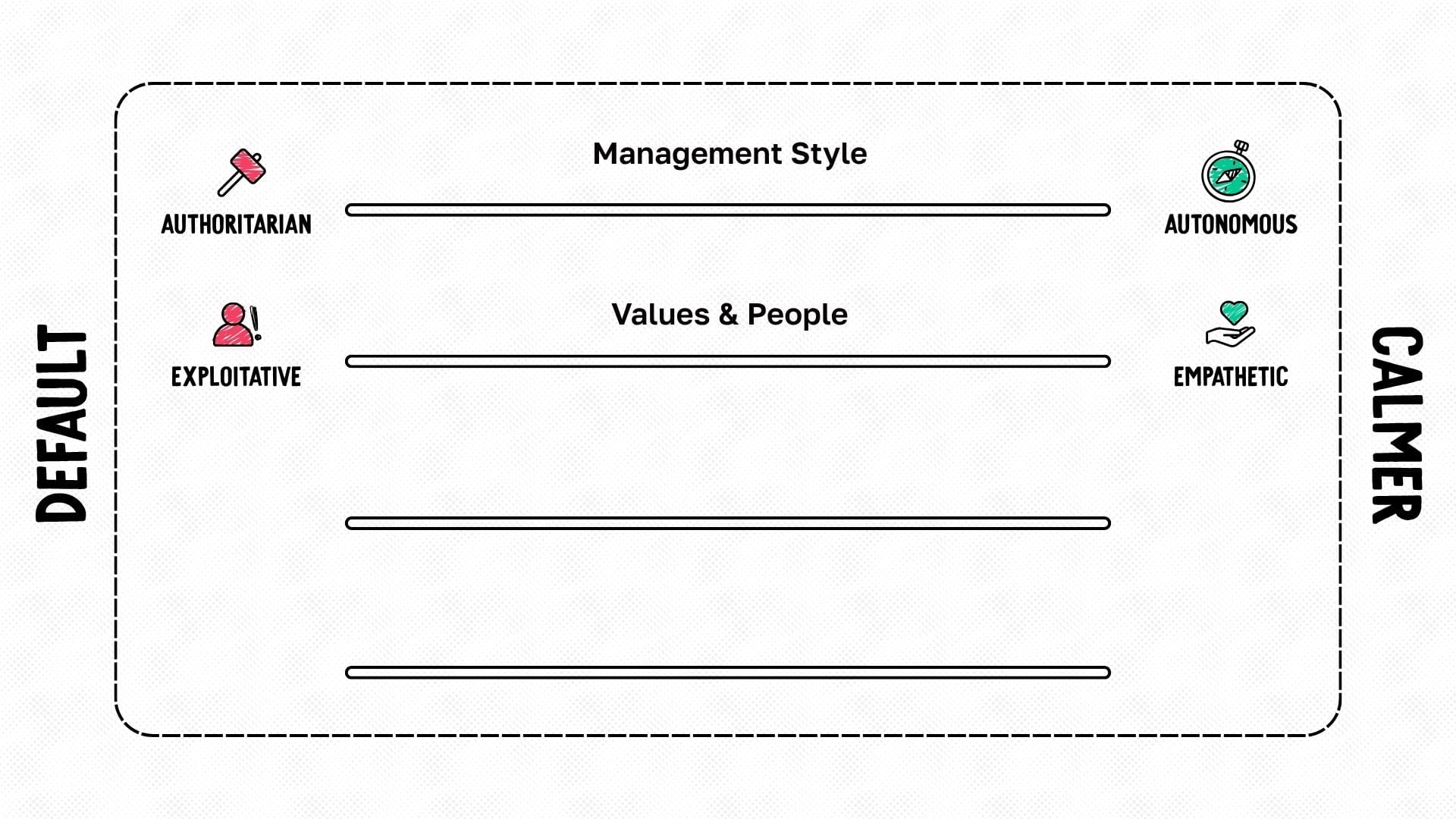
The second lever in The Calmer Framework™ is Values + People, which is all about how you treat the people in and around your business and how you build your values into your culture. It sits on a spectrum between exploitative on the default end and empathetic on the calmer end.
Exploitative doesn't necessarily mean intentionally harmful, it just means the structure extracts more than it sustains. People are inputs to create productivity. Growth is the goal and everything else is secondary. Most small business owners would never describe themselves this way... and are still running businesses built on exactly this logic, because the idea of exploitation being the point is so ingrained in our culture. The focus is really only on output and creating wealth for the people at the top.
On the calmer end, empathetic means the business is actually designed around the humans inside it. Calmer companies actually prioritize empathy. It's about running a business where people feel valued, heard, and supported. You can think of an empathetic business as a people-first, or human-first business. People come before profit and the wellbeing of the people, and working according to their values is a priority.
The Exploitative End
What does the default look like in practice?
You run a service business. Revenue is solid, clients are happy, you've built something real. But you haven't taken a real week off in two years - not a working vacation, an actual week off. Client messages get answered on weekends because it feels wrong not to. When a project runs long or a team member is out, you absorb the extra load. Longer hours, skipped recovery, whatever it takes to keep things moving. You keep telling yourself it's temporary.
It's been temporary for three years.
Meanwhile your team is watching how you operate. Nobody has to say it explicitly, but the implicit message is clear. This is what commitment looks like here. This is what we expect of you. So they push through too. They don't flag when they're overwhelmed because you clearly are and you're not saying anything. The culture gets set by the structure, not the intentions. And the structure says output comes first.
The Empathetic End
Take that same business, but one that's designed to be more empathetic.
You have actual boundaries around your availability (not aspirational ones, real ones). Clients know when and how to reach your team, and they stick to those boundaries. Your team has enough clarity and autonomy that things don't pile up on you when they hit a snag. When a team member has an emergency, the expectation is that they'll take the time they need. Everyone on the team is comfortably working within their capacity most of the time.
And the values of the company are clear. They're part of the onboarding, they're built into the day-to-day. When they say they "care about people," that's actually reflected in how decisions get made, not just in the handbook or some vision statement on the website. Team members don't have to perform wellness or pretend they're fine. They can say they're underwater, and the response is problem-solving, not judgment.
Wellbeing isn't a perk. It's how the business stays functional.
The Business Case (Because There Is One)
SparkToro is a great example of a company that really lives the empathetic/calm company idea. And it makes the business case for this style of business better than any argument I could construct.
Rand Fishkin built his first company, Moz, the default way → 200+ employees, $50M+ in revenue, raising VC money, eight straight years of 100% year-over-year growth. By every conventional metric, it was a success. It also failed to return what it promised investors, burned through people, and eventually led to Rand stepping down as CEO during a serious bout with depression. The structure was doing exactly what it was designed to do - growth at all costs. It just wasn't designed around the humans inside it.
When he co-founded his new company, SparkToro, in 2018 with Casey Henry, he built something explicitly different. They called it "Chill Work", based on the idea that human beings do their best work when they feel psychologically safe, well rested, happy with their jobs, and believe that their work matters.
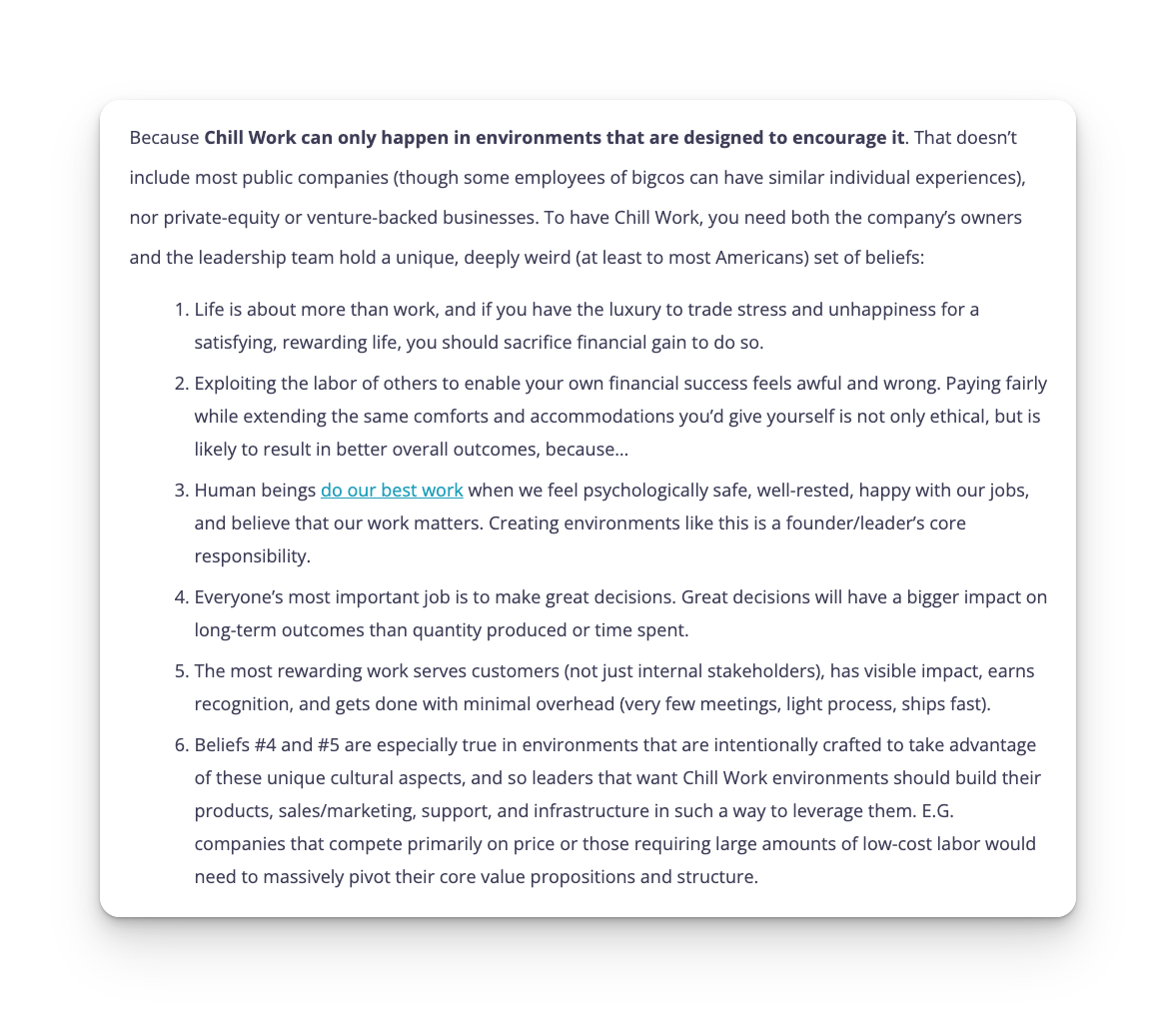
According to SparkToro, Chill Work can only happen in environments that are "designed to encourage it." Which means you need to have six fundamental beliefs:
The results of embodying this Chill Work style are worth paying attention to. SparkToro hit profitability within six months of launching (in April 2020, at the start of a global pandemic) and has been profitable nearly every month since. They passed $1M in annual revenue in 2022. They carry 80%+ gross margins. In June 2023, they repaid 100% of their original investor capital and are on track to pay dividends again. All of that with a team of three people.
For comparison: Rand has said that SparkToro's team of three produces output similar to what Moz regularly produced with a team of 50.
That's not a coincidence. It's what happens when people aren't running on empty. When they're engaged, trusted, working within their actual capacity - they make better decisions, do better work, and stick around. The empathetic end of this lever isn't just nicer to be inside. It's a more efficient, more resilient, more durable way to run a business.
You're Managing Yourself, Too
If you're thinking this doesn't apply to you, as the business owner... you're wrong. For most of the owners I work with, the most extracted person in the business is them. Not because they're doing anything wrong. Because the business runs on their energy as the primary fuel source, and nobody ever stopped to ask whether that was sustainable. Productivity culture doesn't make an exception for the owner - if anything it's worse, because there's no HR, no manager noticing when you're running on empty, and the business always has a good reason for you to push through.
But when you're burnt out and exhausted and overwhelmed, you don't make good decisions. That's not a personal problem, that's a structural problem. One that shows up in your client work, your team relationships, and every call you make from a place of exhaustion. Your capacity isn't just a personal resource. It's operational infrastructure.
Calibrating this lever means treating your sustainability and wellbeing (and your team's) as an actual design input. Not something to protect when things calm down. Something built into how the business runs.
What's Your People + Values Style?
If you're trying to figure out where you land in the spectrum between exploitative and empathetic, here are few questions to reflect on:
- Would you expect a team member to work the hours you work, absorb the stress you absorb, and skip the recovery time you skip? If not - what does that tell you?
- When did you last make a business decision that actively protected your sustainability, even at a short-term cost to output?
- What's the hidden cost of how your business currently runs, and who's actually paying it?
- If the business required you to operate exactly like this for the next ten years, would that be okay?
If those questions stirred something up, that's solid information. It's not a reason to feel bad about how things have been running or to beat yourself up about it. This is what default businesses do - and they get that way because they are, exactly that... a default.
It just means there's room to move this lever, and room to move is where the margins are. The shift you make doesn't have to be dramatic. Pick one place where the business is currently taking more than it's bringing to the table. And then take one tiny action towards something that's more empathetic.
Maybe that's creating a real boundary around weekend availability, one you actually hold. Maybe it's getting honest about which clients or projects consistently drain you and what it would look like to design those out. Maybe it's just starting to ask "what does this actually cost us?" before saying yes to the next thing.
The goal isn't to get all the way to the empathetic end overnight. It's to move the lever slightly, and notice what that creates.
And if you're looking at your answers and thinking the depletion runs deeper than just this lever - if there's no breathing room anywhere and you can't quite see how to get it back - that's exactly what a Margin Reset service is for. We figure out which type of margin is most depleted and what structural shifts would actually address it.

